If you are trying to conceive, ovulation is the one day everything revolves around. Knowing when it happens turns guesswork into a plan. This guide shows you how to calculate ovulation day, read the signs your body gives, and support healthy ovulation naturally.
This is general information, not medical advice. For guidance suited to your cycle and health, speak with a fertility specialist.
Key Takeaways
- Ovulation usually happens about 12 to 16 days before your next period, not a fixed number of days after the last one.
- For a textbook 28-day cycle, that lands around day 14; the simple formula is cycle length minus 14.
- Your fertile window is roughly six days: the five days before ovulation plus ovulation day itself.
- Cervical mucus, an ovulation predictor kit, and basal body temperature each tell you something different; used together they pin the date well.
- Lifestyle matters. A balanced diet, a healthy weight, regular activity, and less stress all support regular ovulation.
- Irregular or absent ovulation often has a treatable cause, such as PCOS or thyroid trouble, worth checking with a specialist.
Quick Answer
To calculate ovulation day, subtract 14 from your average cycle length, counting day 1 as the first day of your period. For a 28-day cycle, ovulation is around day 14; for a 30-day cycle, around day 16. Because ovulation shifts with cycle length, confirm it with real-time signs like cervical mucus changes or an ovulation predictor kit. Your most fertile days are the day of ovulation and the five days before it.
What Is Ovulation and Why Does It Matter for Pregnancy?
Ovulation is the moment one of your ovaries releases a mature egg. That egg travels into the fallopian tube and survives for only about 12 to 24 hours, waiting to be fertilised. Miss that window and the egg is reabsorbed, hormone levels fall, and a period follows roughly two weeks later.
This is why ovulation sits at the centre of conception. Sperm need to be present when the egg arrives, and since sperm can live in the body for three to five days, the best time for intercourse is the days leading up to ovulation. Pinpoint ovulation and you have found the handful of days each month when pregnancy is actually possible. Everything else in this guide is about locating that day.
How to Calculate Ovulation Day Based on Your Menstrual Cycle
The key insight is that ovulation is timed from your next period, not your last. The stretch between ovulation and the next period, called the luteal phase, is fairly constant at about 14 days for most women. So how do you calculate ovulation? Take your average cycle length and subtract 14.
To do this you first need your cycle length. Count from day 1, the first day of full bleeding, up to the day before your next period starts. Track it for a few months and take the average.
How to Calculate Ovulation With a 28-Day Cycle
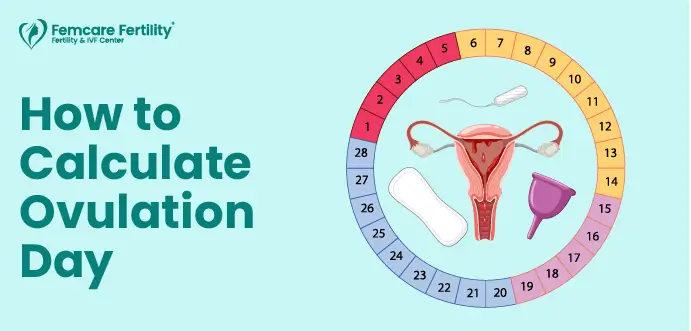
A 28-day cycle is the classic example. Subtract 14 and you land on day 14 as your likely ovulation day. Your fertile window would run roughly from day 10 to day 15. If your cycle is 30 days, ovulation shifts to about day 16; at 26 days, about day 12. Same formula, different result, which is exactly why you cannot borrow someone else’s “day 14.”
How to Calculate Ovulation With Irregular Periods
Irregular periods make the formula shaky, because you cannot predict when the next period will arrive. So how do you calculate ovulation when cycles vary? One practical workaround is to track several months, note your shortest and longest cycles, then estimate a fertile range rather than a single day. For example, if your cycles swing between 26 and 32 days, ovulation could fall anywhere from about day 12 to day 18.
When cycles are very unpredictable, calendar maths stops being reliable on its own. That is the moment to lean on the real-time tracking methods below, which read what your body is doing right now instead of what it did last month.
How to Find Ovulation: 5 Methods to Track Your Ovulation
Learning how to find ovulation usually means combining two or three methods. Here are the five that work, from simplest to most precise.
1. Track Your Menstrual Cycle
Start with a calendar or a period-tracking app. Logging your periods for a few months reveals your average cycle length and the rough midpoint where ovulation is likely. It is the foundation every other method builds on, and it costs nothing.
2. Monitor Changes in Cervical Mucus
Your cervical mucus changes across the cycle. In the day or two before ovulation it becomes clear, slippery and stretchy, much like raw egg white. That “egg-white” mucus is one of the most reliable natural signals that your fertile window is open. Once it turns cloudy and tacky again, ovulation has usually passed.
3. Use an Ovulation Predictor Kit
An ovulation predictor kit is a urine test that detects the surge in luteinising hormone (LH) that triggers ovulation. The LH surge happens about 24 to 36 hours before the egg is released, so a positive result points to your two best days. Start testing a few days before your expected ovulation day.
4. Track Basal Body Temperature
Your basal body temperature, taken first thing every morning before you move, rises slightly, by around 0.2°C, just after ovulation. Charted over a month, that shift confirms you ovulated. The catch is that it tells you after the fact, so it is better for learning your pattern over a few cycles than for timing a single month.
5. Monitor Physical Signs of Ovulation
Some women feel ovulation happen: a one-sided twinge of pelvic pain known as mittelschmerz, light spotting, breast tenderness, or a bump in sex drive. On their own these clues are not precise, but alongside the methods above they help confirm the timing.
What Are the Common Signs That You Are Ovulating?
Beyond the tracking tools, your body often gives a cluster of signals around ovulation. The clearest is the shift in cervical mucus to that stretchy, egg-white texture. Many women also notice a mild ache low on one side of the abdomen, slight breast tenderness, a rise in libido, and sometimes a little spotting. The cervix itself softens and opens slightly.
Not everyone experiences these, and no single sign proves ovulation on its own. Taken together, though, they are a useful real-time confirmation of what your calendar is predicting.
How to Know Your Ovulation Date and Identify Your Fertile Window
Figuring out how to know ovulation date reliably comes down to layering the clues. Start with the calendar estimate, then watch for egg-white mucus and confirm with a predictor kit as the date nears. When two or three signals agree, you have your ovulation day with real confidence. That is how to know ovulation date without second-guessing a single method.
Your fertile window is the six-day stretch ending on ovulation day: the five days before, plus the day itself. The two days right before ovulation are the most fertile of all. Because sperm survive for several days, having sex every day or two across this window gives the egg the best chance of meeting a waiting sperm. If you track nothing else, aim for this window.
How to Improve Ovulation Naturally
You cannot force ovulation, but you can create the conditions for regular, healthy cycles. Learning how to improve ovulation naturally is mostly about steady habits rather than quick fixes.
Maintain a Balanced and Nutritious Diet
What you eat feeds your hormones. A plate built around vegetables, fruit, whole grains, pulses, and lean protein supports the hormonal balance that drives regular ovulation. Wild swings in blood sugar from highly processed food can work against that, so consistency matters more than any single “fertility food.”
Maintain a Healthy Body Weight
Body weight and ovulation are closely linked. Being significantly underweight or overweight can disrupt the hormones that trigger egg release and lead to irregular or missed cycles. Reaching a healthy weight is one of the most effective natural ways to restore regular ovulation.
Exercise Regularly
Moderate, regular activity supports circulation, weight, and stress levels, all of which help your cycle. The nuance: very intense training combined with low body weight can actually suppress ovulation, so the goal is consistent, moderate movement rather than extremes.
Manage Stress and Get Adequate Sleep
Chronic stress and broken sleep raise hormones that can delay or disrupt ovulation. You do not need to eliminate stress, which is impossible, but building in rest, regular sleep, and whatever helps you decompress gives your cycle a steadier footing.
Avoid Smoking and Excessive Alcohol Consumption
Smoking speeds the loss of eggs and harms ovarian function, and heavy drinking can throw off your hormones and cycle. Cutting out smoking and keeping alcohol low are among the clearest things you can do for healthier ovulation.
What Can Cause Irregular or Absent Ovulation?
Sometimes ovulation is irregular or does not happen at all, which is called anovulation. The most common cause is PCOS, a hormonal condition that disrupts egg release. Thyroid disorders, high levels of the hormone prolactin, significant stress, major weight changes, and excessive exercise can all interfere too. The approach of menopause naturally makes ovulation less regular as well.
The encouraging part is that most of these causes are identifiable and treatable. If your periods are consistently irregular or absent, it is worth finding out why rather than guessing, because the right diagnosis usually points to a clear next step.
When Should You Consult a Fertility Specialist?
Trouble tracking ovulation, or cycles that never settle into a pattern, can be worth a professional opinion. As a general rule, if you are under 35 and have been trying to conceive for a year without success, see a specialist; if you are 35 or older, after six months. Do not wait the full stretch if your periods are very irregular or absent, or if you already know of a condition like PCOS or a thyroid problem.
A specialist can confirm whether and when you are ovulating through simple blood tests and ultrasound monitoring, then address any underlying cause. Often the fix is more straightforward than people fear.
Conclusion
Calculating your ovulation day starts with one simple sum, your cycle length minus 14, and gets sharper when you add the signs your body gives: egg-white mucus, a positive predictor kit, a temperature shift. Lock onto your fertile window, support your cycle with steady habits, and you have done the most important part. If ovulation stays irregular or hard to find, that is not a dead end; it is a reason to get expert help and a clear answer.
Take the Next Step Toward Your Parenthood Journey with Femcare
If tracking ovulation has left you with more questions than answers, Femcare Fertility can help. With centres in Pune and Kolkata, our specialists offer ovulation tracking, follicular monitoring, and personalised, evidence-based fertility care, from first assessment through treatments like IUI and IVF. Book a consultation with Femcare Fertility and take a confident next step toward parenthood.
Frequently Asked Questions
How Many Days After Periods Does Ovulation Occur?
It depends on your cycle length, since ovulation is timed from the next period, not the last. For a 28-day cycle it is around day 14, roughly two weeks after your period starts. For longer or shorter cycles, the day shifts accordingly.
Can You Ovulate Without Having Periods?
Yes, though it is uncommon. Ovulation can happen before a period returns, for example after childbirth or when coming off birth control, which is why pregnancy is possible even without a recent period. Persistently absent periods, however, often signal that ovulation is not happening and should be checked.
Can You Get Pregnant Without Ovulation?
No. Conception requires an egg, so without ovulation there is nothing for sperm to fertilise. This is why anovulation is a common cause of difficulty conceiving, and why restoring ovulation is often the first goal of treatment.
How Many Days Does Ovulation Last?
The egg itself survives only about 12 to 24 hours after release. Your fertile window is longer, about six days, because sperm can wait in the body for several days before the egg appears.
How Can I Know If I Am Ovulating Without a Test?
Watch for natural signs: clear, stretchy, egg-white cervical mucus, a mild one-sided ache, breast tenderness, or a rise in libido. Tracking your cycle length on a calendar alongside these signs gives a good estimate without any kit.
Can Irregular Periods Affect Ovulation?
Yes. Irregular periods often reflect irregular ovulation, and conditions like PCOD are a frequent reason. It does not mean you cannot conceive, but it makes timing harder, so tracking methods and a specialist’s input become more valuable.