Introduction
Have you been staring at negative pregnancy test results month after month? If yes, you should know how common this is! In fact, over 15 million Indians have infertility, as per the Indian Journal of Community Medicine, 2024. Mostly, the reason for infertility is clear, such as blocked fallopian tubes, ovulatory dysfunction, or a low sperm count. Other times, doctors find no obvious cause, a condition known as unexplained or idiopathic infertility. So, it’s natural to start looking for options when you reach this stage. And the first treatment you’ll hear of is Intrauterine Insemination or IUI treatment. Want to know if IUI could help you take your first step towards parenthood? Read on to learn about the process, costs, and its success rates.
What is IUI Treatment?
Normally, during conception, the sperm travels through the cervix, into the uterus, and then toward the fallopian tubes, where it meets the egg for fertilization. But in some cases, the sperm is unable to reach the egg naturally. When this happens, your doctor may suggest a treatment called intrauterine insemination.
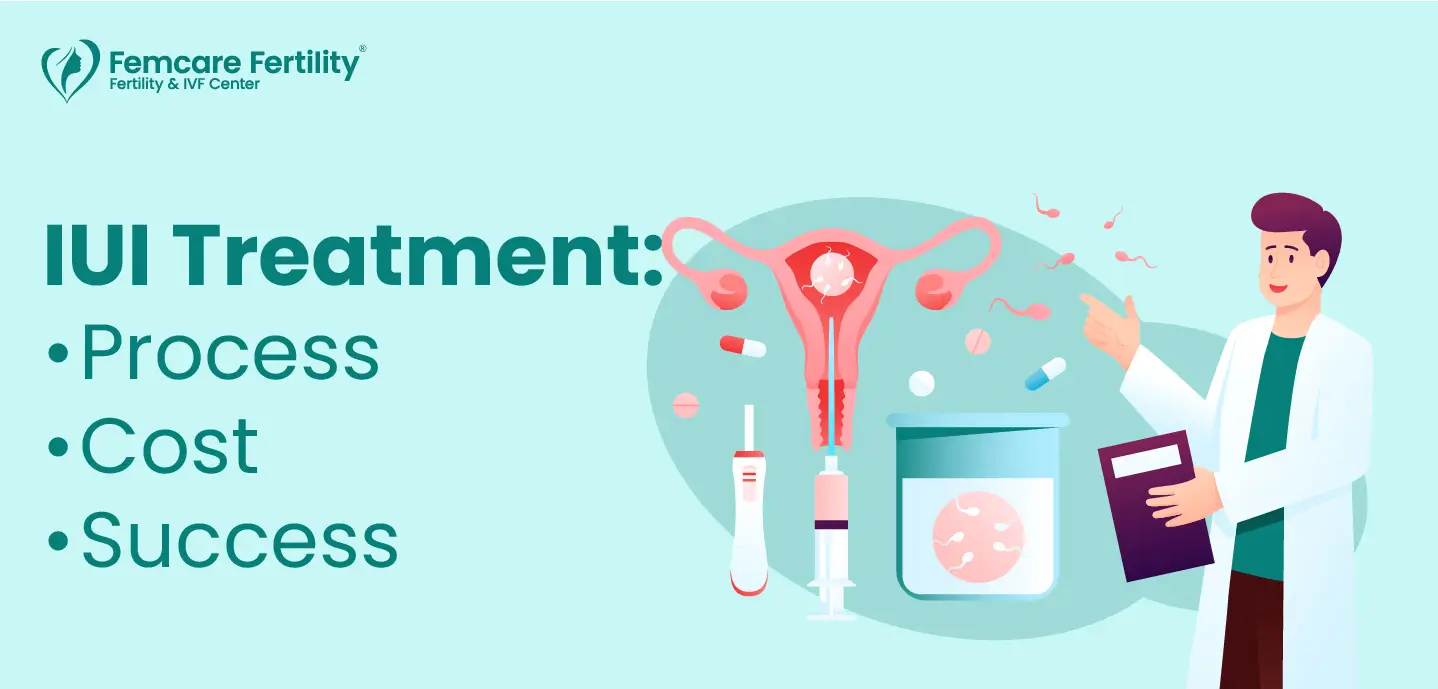
So, Intrauterine insemination, or IUI treatment, is the process of placing sperm directly into a woman’s uterus to induce pregnancy. However, IUI is not always done only when the cause of infertility is unknown. There are other reasons, too, where IUI may be the first line of treatment. And that’s exactly what the next section will cover.
When is IUI recommended?
Your gynaecologist may recommend IUI treatment if you or your partner experiences any of the following:
- Irregular menses leading to irregular release of eggs
- Thick cervical mucus that blocks the movement of sperm
- Low sperm count, reduced sperm movement, or abnormal sperm shape
- Difficulties in erection or ejaculation
- Unexplained infertility
If your gynaecologist detects any of the above symptoms during your tests, you will be advised to go for IUI. And since these symptoms are usually not severe, IUI is often the first-line treatment as it is less invasive and more affordable than other options. So, want to know more about how the entire IUI process works? Keep reading.
Step-by-Step IUI Process
Here’s a clear breakdown of the IUI treatment process so you know exactly what to expect at each step.
1. Initial Consultation and Fertility Evaluation
At first, your gynaecologist may:
- Check your hormone levels (FSH, AMH, and Estradiol) through blood tests
- Perform a pelvic ultrasound to analyse the fallopian tube
- Ask your partner to give a semen sample for sperm count, movement, and shape
These tests help your gynaecologist decide whether IUI treatment is right for you.
2. Cycle Planning and Ovulation Monitoring
Your doctor will track when you ovulate to make sure insemination happens at the right time. Stated below are 3 ways you can track your ovulation:
- Use an at-home ovulation kit
- Go for blood tests at a nearby clinic
- Have a transvaginal ultrasound
Your doctor may also prescribe medicines to help you ovulate. In some cases, you may also get an hCG injection to trigger ovulation at the best time.
3. Timing the Procedure
Your doctor will schedule your IUI process about 24 – 48 hours after ovulation. If you’re using medicines, the timing may be 24 – 48 hours after your hCG trigger shot. Feeling nervous about the big day is normal, but with the right infertility specialist for IUI, you’re in safe hands. Keep reading to know the best one!
4. Semen Collection and Preparation or Semen Washing
On the procedure day, your partner will have to provide a semen sample at the clinic, or you may use the frozen sperm after it has been thawed. The lab then washes the semen sample, also known as semen washing, to:
- Remove seminal fluid and impurities
- Collect the healthiest, most motile sperm
- Lower your risk of cramping
Next comes insemination, which is a painless process.
5. The Insemination Procedure
After semen washing, you are asked to lie on the examination table. Here’s a step-by-step breakdown of what happens during this procedure:
- You place your legs on the leg rests of the table, which helps your gynaecologist clearly view your cervix using a speculum.
- A thin tube called a catheter is inserted into your vagina. The prepared sperm is attached to the end of this catheter, which is then passed through your cervix into your uterus.
- The catheter is slowly removed, and then the speculum.
The entire insemination process takes about 10-15 minutes. Since the process is painless, you are not given anaesthesia.
6. Aftercare
You are asked to rest for a short time after the procedure. Next, you can easily return to your usual activities the same day. Keep in mind the following after the IUI process:
- You may notice light spotting or mild cramping for the next 1 or 2 days or even 6-12 days later.
- Your doctor may prescribe progesterone to prepare your uterine lining for pregnancy.
7. Pregnancy Testing and Follow-Up
You have to wait about 2 weeks after your IUI treatment before taking a pregnancy test. If you test too early, you may get false results, especially if you have used hCG medication. So, your gynaecologist may schedule a blood test, which gives more accurate results. However, if you don’t conceive after the treatment, your doctor may suggest repeating IUI for up to 3-6 cycles before moving on to other treatments like IVF.
Now that you know how the IUI process works, the next big question on your mind is likely, What are the chances of success? Let’s answer that in our next section.
IUI Treatment Success Rate
The success of IUI treatment depends on the woman’s age, the cause of infertility and the use of fertility drugs. Here’s a rough breakdown:
| Age Group | IUI Success Rate per cycle |
| Under 35 | 15-20% |
| 35-37 | 10-12% |
| 38-40 | 7-10% |
| Over 40 | 3-9% |
Moreover, the IUI process success rate mainly depends on a woman’s age, as AMH (anti-Müllerian hormone) levels, which reflect a woman’s egg reserve (the number of eggs left in the ovaries), start to decrease after 25. So, with a lower egg reserve, fewer and lower-quality eggs are released. That’s why it’s best to reach out early if you face fertility problems. You may also consider freezing your eggs for the future to improve the IUI success rate by age.
Wondering where you can get started? Well, if you are looking for the best IUI treatment in Kolkata, Femcare Fertility offers nothing but the best! Experienced fertility specialists, well-equipped labs for sperm washing, and transparent cost structures so you know what to expect.
Take Your First Step Towards Parenthood with Femcare Fertility
IUI treatment is one of the simplest, least invasive ways to improve your chances of pregnancy. And when you walk into Femcare Fertility, known as the best IUI centre in Kolkata and Pune, you’re trusting healthcare professionals who have a consistent track record at what they do. So, don’t lose hope, give us a call at 9967050566 to schedule your first appointment and take your first step towards parenthood.
FAQs (Frequently Asked Questions)
Question: Is IUI better than IVF?
Answer: Not always. Both IUI and IVF are designed for different causes of infertility. IUI treatment is usually the first option as it is simple, less invasive, and affordable, especially for mild problems like unexplained infertility, cervical issues, or slightly low sperm motility. IVF, on the other hand, is more advanced and helps in cases like blocked fallopian tubes, very low sperm count, or when IUI hasn’t worked. The best part is that if you’re looking for a free consultation, Femcare Fertility is the best IUI centre in Pune and Kolkata for you.
Question: What are the factors affecting IUI success?
Answer:The success of IUI treatment depends on the following:
- Age (fertility decreases after 25)
- Egg quality
- Uterine health
- Sperm quality and quantity
- Lifestyle (smoking, obesity, alcohol)
- Number of cycles attempted

